
The Science of Soft Washing: Why We Use Sodium Hypochlorite
Why pressure alone never quite finishes the job
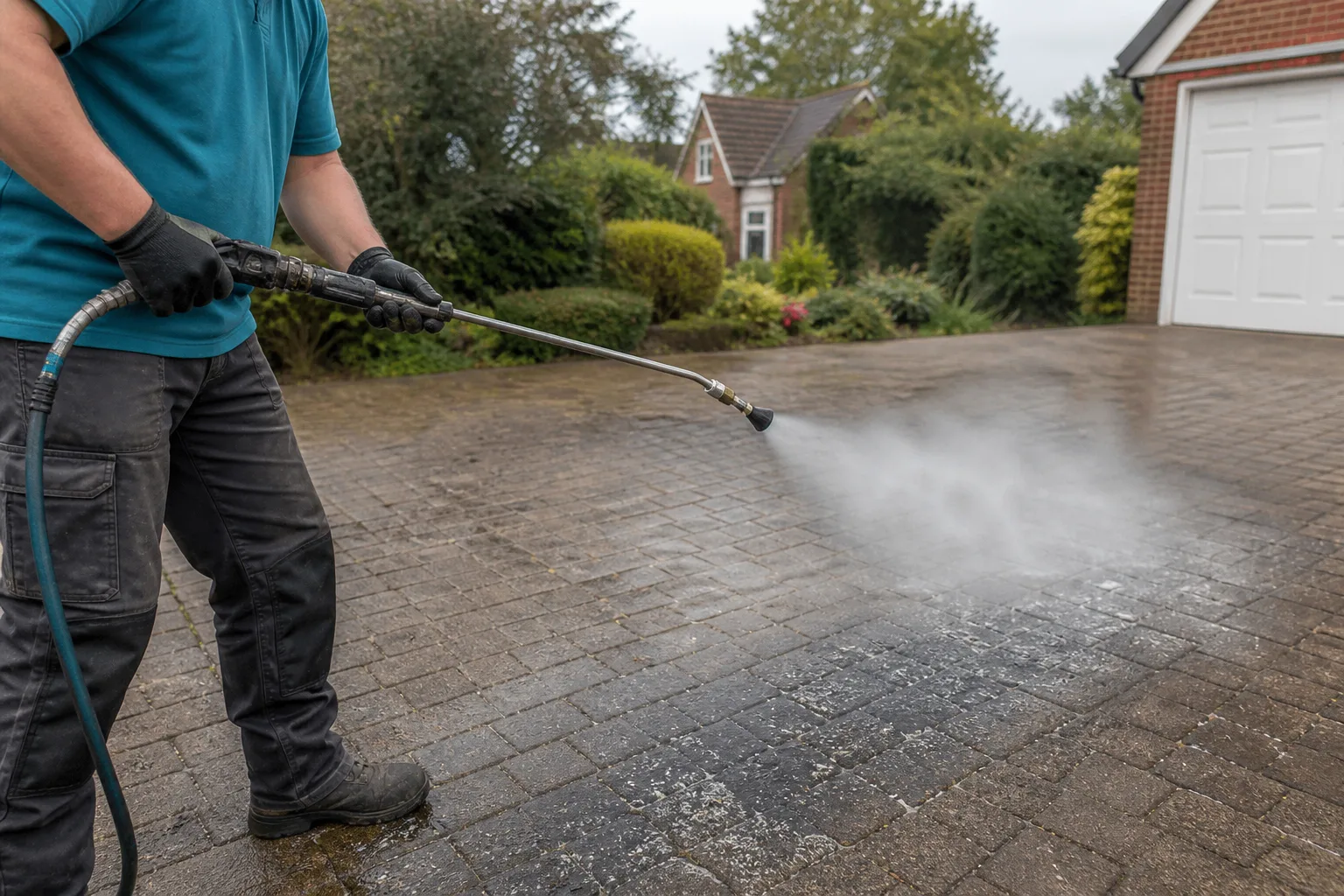
A rotary surface cleaner running at 200 bar is a genuinely impressive thing to watch. It strips the top layer of dirt off block paving in seconds and leaves behind that sharp, clean line between the cleaned strip and the grubby strip next to it. It looks like the job is done.
It usually isn't, and the reason is biological rather than mechanical.
The green film on a driveway is algae. The black spots that look like someone flicked tar at your paving are lichen, a partnership between a fungus and an algae that is remarkably good at surviving. Both organisms anchor themselves into the pores of the stone. Concrete blocks, Indian sandstone and tarmac are all porous to some degree, and those pores run several millimetres down into the surface.
Pressure removes what sits above the surface. It does very little to the root structures and spores sitting inside it. That is why a driveway cleaned with pressure alone often looks superb for six weeks and then starts greening up again from exactly the same spots. Nothing was killed, so everything grew back.
What sodium hypochlorite actually does
Sodium hypochlorite is the active ingredient in household bleach, and in the exterior cleaning trade it is the standard biocide for organic growth. Applied at a suitable dilution it oxidises the cell walls of algae, moss, lichen and the fungal component that binds lichen to the stone. The organism is killed rather than trimmed.
The critical word is dilution. The concentrations we use are considerably lower than most people expect. Applied at the correct strength through a low-pressure fan spray, the solution is given time to dwell on the surface, does its work, and is then thoroughly rinsed away. Applied carelessly at high strength, it damages plants, discolours some stone types and corrodes metalwork. The chemistry is straightforward; the professional part is the dilution, the dwell time and the containment.
This is what the trade means by soft washing: low pressure, correct chemistry, adequate dwell time. The cleaning is done by the treatment, not by force.
Why low pressure protects your driveway
There is a second, quieter argument for soft washing, and it matters more on some surfaces than others.
High pressure erodes. On concrete block paving it gradually removes the fine cement-rich surface layer, exposing the aggregate underneath and leaving the blocks looking rough and lighter than they should. On Indian sandstone it can pick out the softer bands in the stone. On tarmac it lifts the bitumen binder and loosens the stone chippings, which is how a driveway ends up with a permanent scoured patch where someone lingered too long with a turbo nozzle.
Where growth is heavy we still use pressure, because organic matter that thick has to be physically removed. But the pressure is a tool for lifting debris, not for killing anything, and it is applied with a controlled sweep at a sensible distance rather than held in one spot.
How we sequence a soft wash
A typical Greater Manchester driveway with two or three winters of neglect runs roughly like this:
- Protect the surroundings. Borders, lawns and plants are wetted down first. Wet foliage absorbs far less of anything that drifts onto it, and metal fixtures and any nearby vehicles are covered or rinsed.
- Pre-treat. The biocide is applied at low pressure across the whole area and left to dwell. On heavy black lichen this is where the work actually happens, and it is not quick.
- Mechanical clean. Once the growth has been killed and softened, the surface is cleaned with a rotary head to lift the dead organic matter, ingrained dirt and old jointing sand.
- Rinse thoroughly. The whole area, plus the borders and any adjacent surfaces, is rinsed down so no residue is left sitting on the stone or in the soil.
- Re-sand, on jointed surfaces. Kiln-dried jointing sand is brushed back into the joints once the surface has dried. On block paving this step is not optional, and it is covered in detail in our guide on jointing sand. Concrete, tarmac and resin have no joints to fill, so for those the clean is the finish.
What a good result looks like six months on
The honest answer is that no treatment is permanent. Greater Manchester is damp, shaded, and algae spores travel on the wind, so a north-facing driveway under a tree will always be working against you.
What a proper soft wash buys you is a genuine reset rather than a cosmetic one. Killing the organism instead of shaving it off means regrowth starts from nothing and takes far longer to become visible. In our experience a soft-washed and re-sanded driveway holds its appearance for a couple of years rather than a couple of months, and a follow-up sanitise treatment extends that further.
If your driveway has gone black or green and you would like to know whether it needs a full clean or only a treatment, send us a photo and we will tell you honestly which one you are looking at.
Related guides
More practical advice on keeping your driveway, patio and paths looking their best.
Send us a photo. We'll tell you what it costs.
One fixed price back, with everything your surface needs already in it. Nothing added later. If you don't like the finish, we don't leave.